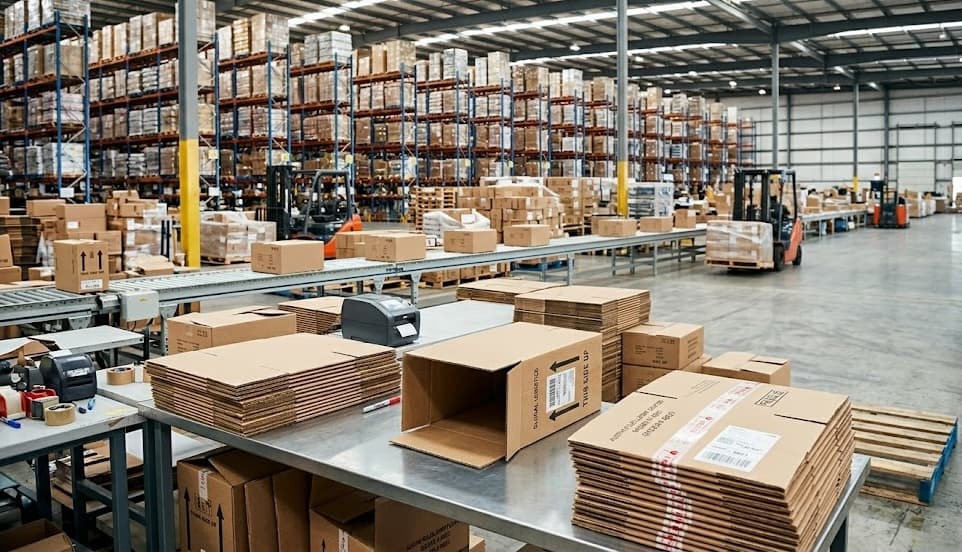
Inbound docks (18 bays)
Every truck that pulls in gets weighed, checked against the BOL, and routed to one of three receiving lanes. Our dock supervisor hand-logs each pallet before the forklift even touches it.
Grading tables
Four grading stations with knee-high rollers. A trained inspector eyeballs every box, stamps it A, B or C, and marks dimensions on the pallet card. No box leaves Zone B unmarked.
Reclaim & re-tape
Boxes with salvageable flaps get re-taped with water-activated gummed paper tape (not plastic) and get a second grade stamp. Anything we can’t save goes to the baler.
Baler & OCC bunker
A 60-horsepower vertical baler handles about 120 tons of OCC per month. Bales are wired, tagged, and stored under roof before being sold to downstream paper mills.
Outbound storage
Graded stock is staged on drive-in racks by dimension and grade. Each bay is labeled with its stock keeping unit and our WMS can locate any pallet in under 90 seconds.
Dispatch hut
Our dispatch hut overlooks the yard, runs on two screens and an analog clipboard. This is where routes get built every morning at 5:30 a.m. before the first driver shows up.
Want the real tour?
We’re happy to host partners, journalists, sustainability teams and curious school groups. Drop us a note through the form above. You will need close-toed shoes and ideally not a hi-vis vest we have to lend you.
The numbers behind the building.
- 64,000 square feet total under roof, expanded from 32,000 in 2025.
- 18 inbound dock doors and 6 outbound staging bays.
- 22-foot ceiling height in the main yard, allowing 4-high gaylord stacks.
- 4 grading stations running in parallel during peak weeks.
- 1 vertical baler handling about 120 tons of OCC per month.
- 1 yard scale at the inbound dock. Every truck weighed in and out.
- 6 forklifts in the active fleet, with one push-pull attachment.
- ~4,000 pallet positions in drive-in racking across Zone E.
- 1 dispatch hut overlooking the yard, with two screens and a coffee maker that has seen a lot.
How a typical morning unfolds.
The first truck rolls in at 5:30 a.m., usually a long-haul return from somewhere in Wyoming or New Mexico. Marisol checks the BOL, weighs the load, and hands the driver a stack of pallet cards for the morning’s inbound staging. By 6 a.m. the dispatcher has built the day’s outbound routes, the first delivery driver is loading at Zone B, and the grading tables are warming up for the day. By 7:30 a.m. all four grading stations are running and the yard sounds like a baseline-level industrial operation: forklifts beeping in reverse, pallets hitting concrete, the occasional shouted joke between graders. The first outbound truck leaves at 6:30, the second at 7:00, the third at 7:45. By 9 a.m. the morning rush is over and the floor settles into a steady rhythm that lasts until the afternoon turnaround at 2 p.m.
What we built ourselves.
The grading tables, the pallet card system, the WMS, the route builder, the diversion certificate generator, and the bale tagging system are all home-grown. We have written about a few of these in our blog post on the WMS. The cost of building these tools ourselves was dramatically lower than buying commercial software, and the tools fit our operations perfectly because we wrote them around the workflow we already had.
Visiting the yard.
We host visitors most weeks. School groups, sustainability teams from larger companies, journalists writing about packaging, partners from downstream paper mills, and the occasional curious neighbor. Tours run about 45 minutes and cover the inbound docks, the grading tables, the baler bunker, and the dispatch hut. We ask visitors to wear close-toed shoes (we have spare hi-vis vests if you forget yours) and to email ahead so we can stage your tour with somebody from the team rather than pulling somebody off a forklift.