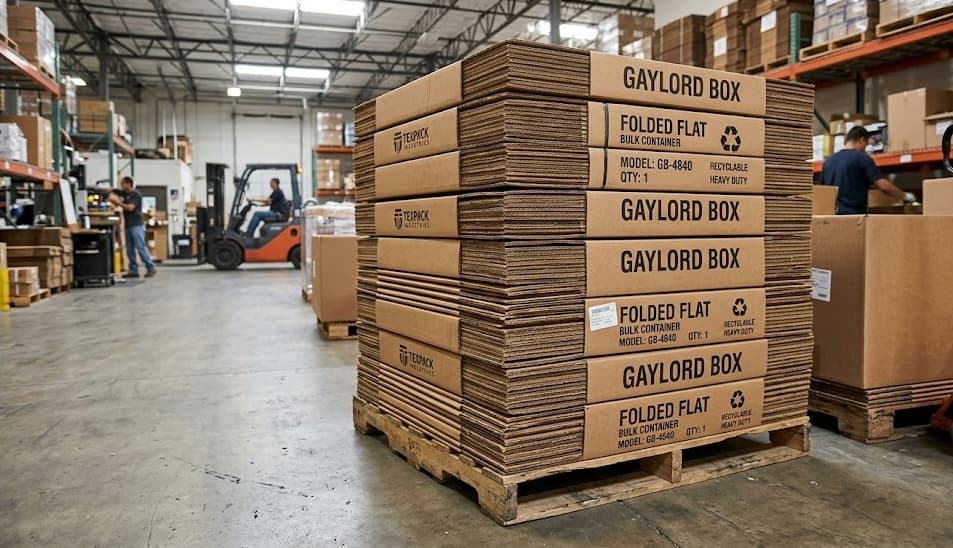
What is a gaylord box?
A gaylord is a corrugated bulk container, usually 40"×48" footprint (pallet-sized) and anywhere from 24" to 48" tall. It can be singlewall, doublewall, triplewall or quadwall depending on load. The name comes from the Gaylord Container Corporation, which made the first ones in the 1930s — the word stuck, and now every giant corrugated box in North America is called a gaylord regardless of who built it.
What we keep in stock.
| Footprint | Wall | Height | Load rating | Typical use |
|---|---|---|---|---|
| 40" × 48" | Doublewall | 36" – 48" | 1,800 lbs | General bulk, grain, parts |
| 40" × 48" | Triplewall | 36" – 48" | 2,400 lbs | Heavy bulk, scrap metal |
| 48" × 48" | Doublewall | 36" – 44" | 1,600 lbs | Textiles, cardboard bales |
| 45" × 48" | Triplewall | 40" | 2,200 lbs | Automotive, foundry |
| 30" × 30" | Singlewall | 30" | 800 lbs | Light bulk, returnables |
Grading.
We grade every gaylord A, B or C before it leaves our yard. See the full grading guide.
- Grade A — once-used, clean, intact flaps, no visible damage. Ideal for food-adjacent uses and brand-facing applications.
- Grade B — 2–3 trips, minor scuffs or label residue, fully structural. Ideal for industrial bulk, back-of-house, warehouse.
- Grade C — visibly worked, intact structure, possible re-tape on flaps. Ideal for dunnage, scrap collection, internal moves.
Pricing.
Roughly $7–$14 per gaylord depending on wall, grade and quantity — that is one-quarter to one-half the price of a comparable new box. We quote in writing with delivered freight included; no surprises on invoice day.
Minimum order.
One full pallet (48 folded-flat gaylords) for delivered orders. Smaller quantities are available for pickup at our W 2nd Ave yard with 24 hours notice.
Don’t see your size?
Our inventory rotates weekly. If it’s a common footprint, we probably have it but haven’t listed it here. Fill out the form above with the dimensions you need and we’ll reply with what’s on the floor today.
Common applications, by sector.
- Cannabis: cure-room storage, drying transfers, packaging-line buffers, processing waste consolidation.
- Breweries: spent-grain hauling, hop bag dunnage, malt sack staging.
- Agriculture: harvest field bins, pack-house consolidation, root-crop storage.
- Automotive & foundry: parts transfer, casting moves, scrap consolidation.
- E-commerce & DTC: returns sortation, inbound consolidation, closed-loop shipping.
- Manufacturing: line-side dunnage, inter-plant transfers, seasonal overflow storage.
- Recyclers: sorted material consolidation, baler feed staging.
- Schools and community gardens: raised-bed liner, compost storage (free with our community program).
How a gaylord is made.
A standard doublewall gaylord starts as three rolls of kraft liner and a roll of fluted medium that come off the corrugator as a single sheet of double-walled board. The sheet runs through a die-cutter that scores eight crease lines and cuts the four top flaps. The blank is folded once during shipping to flatten it. When it reaches the customer, the bottom flaps are tucked and taped, the box is opened up to its full height, and it’s ready to receive a load. Most gaylords get used at least once this way before being baled or — better — making it to our yard for a second life.
What “ECT” means and why you might care.
ECT is the Edge Crush Test rating, measured in pounds per linear inch. It tells you how much vertical compression the board can survive before crushing. Standard gaylord stock runs ECT 48 to ECT 72 depending on wall and flute, with triplewall and quadwall stock pushing into ECT 90+ territory. ECT matters most when you’re stacking gaylords on top of each other — every box in a column is supporting all the boxes above it, so the ECT needs to be high enough to prevent the bottom box from collapsing.
How to specify a gaylord without a converter’s help.
- Pick the load weight first. That sets your wall type.
- Pick the footprint based on your forklift and your dock.
- Pick the height based on the product depth and your stacking plan.
- Pick the grade based on your application and budget.
- Tell us. We’ll quote what’s on the floor today.
Pricing context.
For a typical doublewall 40"×48"×40" gaylord: new stock runs $24–$38 per unit depending on minimum order and lead time, our reclaimed grade A runs $10–$13, grade B runs $7–$9, and grade C runs $5–$6. Triplewall stock runs roughly 50% higher across all grades. Bulk volume discounts kick in at 500 units (5%), 1,000 units (8%), and 2,500 units (12%). See our full pricing page for the complete table.
Sustainability impact, per gaylord.
- ~21 kg CO₂e avoided per unit versus new (90%+ reduction).
- ~400 gallons of water saved per unit versus virgin pulp production.
- 0 trees harvested per unit (versus ~1 tree per 23 new units).
- ~$1.20 of bale value preserved by keeping the box in service rather than recycling it.
Gaylord box FAQ.
How long does a reclaimed gaylord last?
Typical doublewall stock survives 4–6 trips after we ship it. Triplewall stock survives 6–10. Cycle life depends heavily on load type, handling, and storage conditions — wet loads and rough handling shorten the life dramatically.
Can I stack reclaimed gaylords four high?
Yes, with caveats. Grade A doublewall can stack 4 high under the manufacturer’s rated load. Grade B and C should be stacked 3 high to be conservative. Triplewall can stack 5+ high in most rack systems.
What if a gaylord arrives damaged?
Photograph it, email us, and we’ll either credit the unit or replace it on the next delivery. Damaged units almost always represent shipping damage rather than yard error, but we own it either way.
Are the boxes cleaned before shipment?
Visually inspected, dust-blown, and re-taped if needed. We don’t pressure-wash because pressure-washing destroys corrugated. If a box looks dirty enough that washing would help, it goes to a lower grade or gets baled.
Can I order one specific footprint as a recurring order?
Yes — recurring orders are easy to set up. We schedule the shipments on a fixed cadence and adjust quantities each month based on your actual usage.