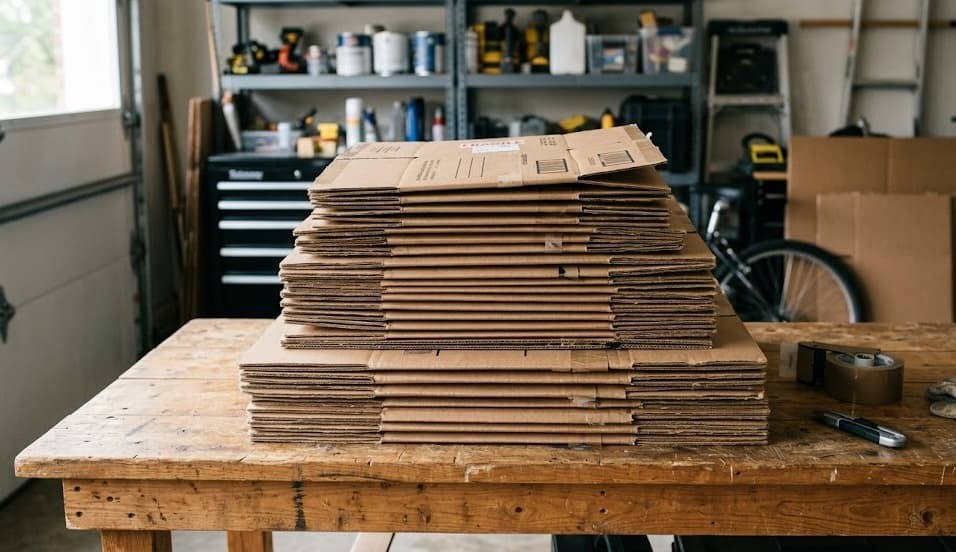
2011 — The garage.
Our founder rented a 1,400-square-foot garage off Broadway and made a deal with a local grain mill: take away their empty gaylords for free and do whatever we want with them. We stacked them four high on the floor, sold them to a metal shop three blocks away for $11 apiece, and went out and bought a second pallet jack. That was the whole business plan.
2013 — The first truck.
Two years in we realized the math on used boxes doesn’t work without freight. If the customer has to come to us, we’re a flea market. If we come to them, we’re logistics. We bought a 26-foot box truck off a retiring locksmith, painted the Denver Eco Boxes name on both sides, and started doing milk runs across the Front Range every Tuesday and Friday.
2016 — The yard.
The Broadway garage couldn’t hold another pallet. We signed a lease on 32,000 square feet at 2350 W 2nd Ave and put down 18 dock doors, two loading pits and a baler big enough to eat half a semi of OCC in a day. The yard is still our headquarters.
2019 — The grading system.
After eight years of selling reclaimed gaylords we were tired of arguing with customers about quality. We wrote down a three-grade system — A, B, C — and stapled a laminated copy to every dock door. Every box leaves our yard with a grade, and if you disagree with the grade on delivery we take the load back and pay the return freight.
2021 — The first closed loop.
A Boulder-area DTC brand asked if they could get the same 40 gaylords back every week. We built the first closed-loop program in our history: routed pickup, routed delivery, dedicated grade-A inventory, barcoded pallets. Today we run fourteen closed loops for companies across Colorado, Wyoming and New Mexico.
2024 — Where we are now.
Today Denver Eco Boxes is still family-owned, still headquartered on W 2nd Ave, and still run by the same stubborn idea: if a box is structurally sound, it should not be in a landfill. We move roughly 3,500 gaylords a month, bale about 120 tons of OCC, and turn the occasional retired box into a garden planter for a neighborhood school. Same plan, bigger yard.
2025 — The expansion.
Last year we expanded the yard from 32,000 to 64,000 square feet, adding a second baler bunker, six more dock doors, and a small office for the dispatch and customer service team. The expansion was funded out of operating cash flow and timed to a regional uptick in demand from cannabis cultivators and DTC brands. We now run fourteen active closed-loop programs, cycle about 90,000 boxes per quarter, and process around 14 metric tons of OCC per week through the baler.
The people who built it.
Denver Eco Boxes is a small company. The whole team fits in a single dock-area meeting once a week. The founder still drives a forklift on occasion. Our operations lead has been here since 2014 and runs the customer side. Our dispatcher has been here since 2014 and routes every truck. Our yard lead joined in 2018 and runs the grading and inventory side. Our sustainability analyst joined in 2021 and produces the audited reports. Six CDL drivers, four graders, two part-time office staff, and the founder. That’s the whole company.
What we’ve never changed.
- The address. We’ve been at 2350 W 2nd Ave since 2016.
- The phone number. We’ve never had one.
- The email reply policy. One business day, written by a human.
- The grading rubric. Same A/B/C system, refined but not replaced.
- The diversion methodology. EPA WARM, audited annually.
- The mission. Keep corrugated out of the landfill.
What we have changed.
- The size of the yard (4×).
- The size of the team (10×).
- The size of the WMS database (~1,000×).
- The number of standing routes (from 1 to 6).
- The number of closed-loop programs (from 0 to 14).
- The number of states we ship to (from 3 to 11).
- How we quote (per ton → per unit).
- What kind of tape we use (plastic → gummed paper).
- How we publish our impact numbers (annual blog post → audited report).